This publication examines the essential role of language development in promoting inclusion and educational equity in Nordic schools. As classroom diversity increases, students with migrant backgrounds face a heightened risk of falling behind academically, as limited proficiency in the language used in school can restrict their participation in learning and school life.
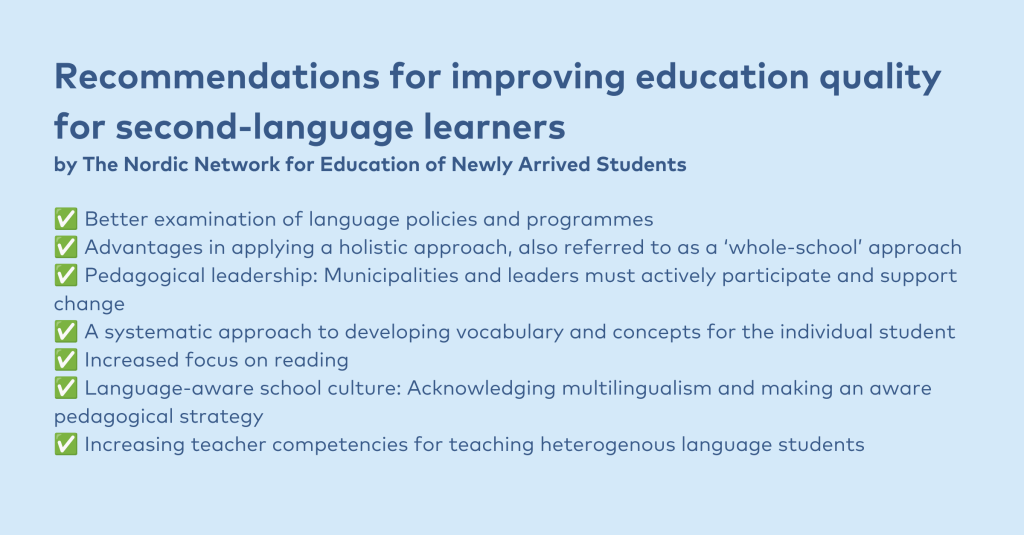
Based on a Nordic research review and expert insights from a 2025 Nordic Welfare Centre webinar, the report shows that strong skills in the host country language are key to learning, participation, and social inclusion. The results highlight major differences among learners and approaches, the strong impact of age of acquisition, and the importance of focused support for older students. Experts emphasize that successful language development depends not only on individual effort and motivation, but also on systemic factors such as opportunity, strategy, school organization, and teacher competence. The report calls for coherent, evidence based language policies, a wholeschool approach, strengthened pedagogical leadership, and individualised learning plans. Recognising the student’s multilingualism as a resource. The researchers concludes that tailored strategies and improved data are essential to support second language learners and foster inclusive education across the Nordic countries.
Background information: Language is the key to society, and society is the key to language!
This publication is aimed at:
- Policymakers and decision-makers
- Public authorities and education administrators
- Principals and school leaders
- Teachers and student support staff
- Researchers and education developers
- Organisations working with integration and inclusion
Key findings
- Language is the foundation of inclusion: Language is not only about academic achievement. It is also essential for participation in school, building relationships, and developing a sense of belonging.
- Students have different needs: There is no one-size-fits-all solution. Effective support must take into account students’ age, previous experiences, linguistic background, and local school contexts.
- Multilingualism is an asset: Schools should build on students’ existing language skills. Supporting both the mother tongue and the Nordic second language can strengthen learning and inclusion.
- Teacher competence matters: Language-aware teaching, strong pedagogical leadership, and continuous professional development are key factors in improving outcomes.
- More knowledge is needed: Researchers call for better data and more studies to provide policymakers and practitioners with a stronger evidence base for future language initiatives.